
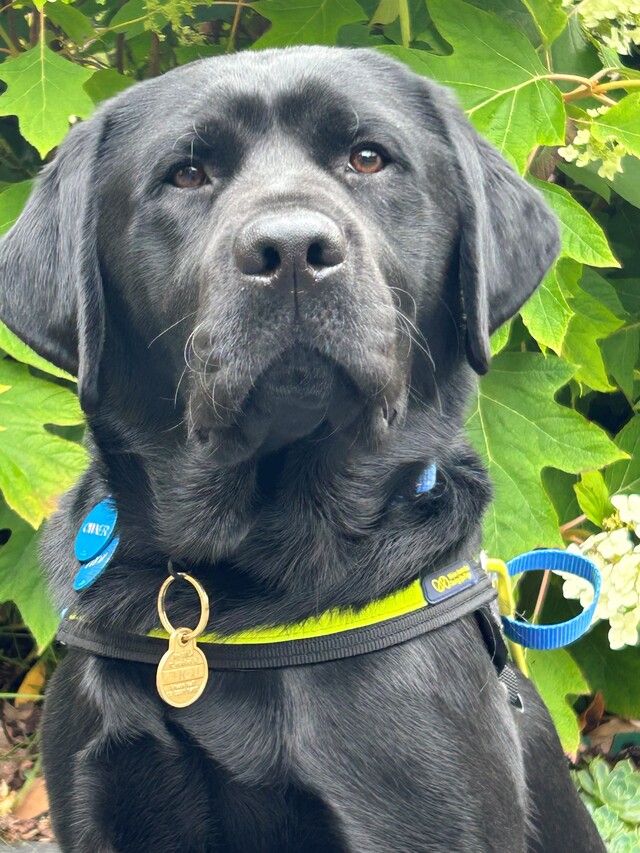
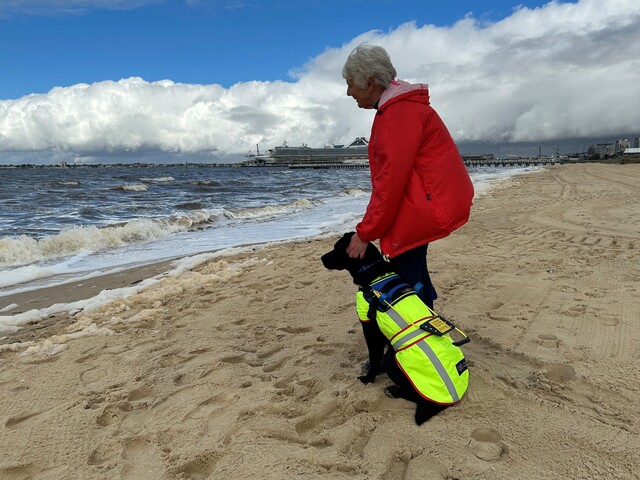
In 1974 Kate Watkins got her first Seeing Eye dog, a moment she’ll never forget.
She finished high school on the Friday. The following Monday she was at Seeing Eye Dogs Australia then in Malvern being matched with Troika, a two-year-old golden labrador.
Since then Kate, who is legally blind, has had a further seven Seeing Eye dogs – Abbey, Letice, Quarry, Qiana, Selwood, Clayton and now three-year-old Kramer.
The Upper Ferntree Gully NDIS participant said she adores Kramer, and she takes him everywhere, even caravanning and camping with husband of 45 years Ian.
“Kramer has his own bright yellow camping jacket, Fluro collar and lead,” she said.
“His bed has lights built into it, so we can see him when we’re sitting around the campfire.”
While Kate admits it is stressful retiring each dog, she says it’s all been worth it.
“I wouldn’t be where I am today without them all,” she said. “I’ve survived quite happily. I’m a wife, mum, grandma and I’ve worked lots of jobs over the years.
“I decided to retire 11 years ago, but it just wasn’t for me. Now I work for Vision Australia 15 hours a week, helping others with vision impairments. I love it. Always busy is the best way to describe me,” she said.
Last year Kate retired Clayton. Fortunately he was rehomed to his original puppy carers.
“He was getting a bit slow, but now he’s living his best life. He just turned nine and apparently for his birthday he got a muffin and an extra carrot in his breaky,” she said with a laugh.
While Clayton is now enjoying a whole new life Kate emphasises there’s much more to working with Seeing Eye dogs than people realise and being matched with a dog and learning to make it work for you can be tricky.
“While they come from the schools well-trained, it doesn’t stop there,” she said.
“It’s down to the handler to make sure their dog stays as good as the day they got it.
“Under the International Guide Dog Federation all member organisations are responsible for developing, monitoring and evaluating their dogs. It means trainers must work with you and your dog when you go home for as long as you need them. You can also stay at the school, which is in Kensington, 10 minutes out of Melbourne’s CBD.
“Most people usually stay at the school first, but for me I like to do home-based training first. It’s because when I’m at home I’m relaxed and if I’m relaxed my dog is too.
“Then I stay at the school for a week. Being close to the city is good. I get to train with my dog in busy places. We are up and down lifts and escalators then they get used to it.”
While everyone is different and training times vary, Kate says during sessions there are a lot of boxes trainers must tick off to ensure a dog is competent to work with its handler.
“Some people will take one or two weeks to do their training, others might take six weeks or longer. It all comes down to the experience of the person getting the dog,” she said.
“If you’ve never been around dogs or other animals before you won’t know how to relate to a dog the same way as someone who has grown up with pets.
“Bonding is really important, and if you have never had an animal, there’s a lot to learn. You can’t just pick up a harness and expect your dog to work.”
Kate said people should remember as beautiful and adored as working dogs are, we must ignore them while they are working and not pat, feed or talk to them.
“Unfortunately, people forget this. These dogs are beautiful and brilliant, but we have rules and people must stick to them,” she said.
“When I’m out people always want to touch Kramer and I politely say, ‘Sorry, you can’t.’
“You must never touch or acknowledge a working dog while it’s in its harness. Any distraction like a pat or someone talking to the dog or making a fuss of it can lead to serious complications for the handler.
“I could be crossing a road and if my dog is distracted by someone talking to him, I could be hit by a car. People don’t realise it can be a matter of life or death.
“People should know, and the handlers should know, don’t give in to people and let them pat and talk to your dog. It’s just easy to say, ‘Please don’t.’”
The NDIS is now providing support to more than 646,000 Australians, with more than half receiving support for the first time. Kate is one of more than 168,000 participants in Victoria benefitting from the Scheme.