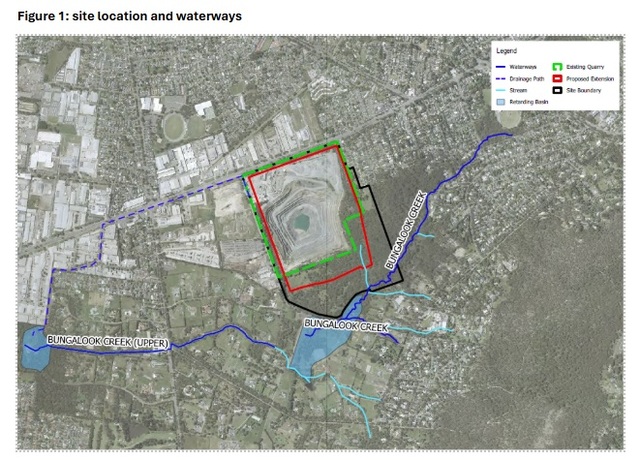
The environment surrounding the Montrose quarry is unique; to one side is dense bushland and on the other are commercial buildings and a major arterial road.
It is also a populated residential area, with housing and large properties dotted around the perimeter, and an essential waterway running through.
Montrose itself has been described as the “gateway to the Dandenong Ranges” and provides an important nature corridor for numerous species, according to long-standing environmentalist Kim Wormald.
Protecting this natural environment, and the safety and security of houses, rank as two of the highest priorities for the Stop the Montrose Quarry Expansion group.
Member of the group and retired engineer Phillip Dane said the best outcome would be a complete rejection of the expansion “on environmental grounds” or, secondly, a full environment effects statement (EES) be required.
Mr Dane said an EES is the “highest level of environmental assessment in Victoria” and is an expensive, timely and effortful exercise.
Boral has submitted the required referral documentation to planning minister Sonya Kilkenny, who is the sole decision maker on either the approval, rejection or requirement for an EES.
In 2004, when Boral last sought an extension of the quarry, it was required to complete an EES. The extension was ultimately refused in 2008.
The current proposal from Boral has been calculated by the Stop Montrose Quarry Expansion group as 58.2 per cent larger than the previous expansion request.
When asked why they were pushing for a larger extraction zone than in the rejected 2008 proposal, a Boral spokesperson said “this project is not related to the 2008 project”.
“The current project proposes a different extraction area (including extension to the east and a different area of extension to the south), with different and reduced environmental impacts,” they said.
“The current regulatory framework applicable to the project has also significantly changed since 2004, with different legislative requirements governing extractive industry planning and environment approval outcomes.”
But the new extraction zone has caused widespread worry due to the closeness of the blast zone to houses and schools.
The Environmental Protection Authority (EPA) updated guidelines for separation distances between quarry activity and residences were increased from 250 metres to 500 metres in 2024.
In Boral’s blast impact assessment document, it identifies “there is estimated to be 150-200 residences (occupied houses) within 500m of proposed future operations”.
“The closest located at Ash Grove and Kirkwood Court to the immediate northeast. Eight residences within 500m are identified along Jeanette Maree Court to the southwest, and five residences on Sheffield and Glascow (Glasgow) Roads to the south.
“The closest houses and their minimum separation distance to the proposed Limit of Blasting are; 33 Ash Grove, 160m northeast, 13 Jeanette Maree Court, 205m southwest, and 245 Sheffield Road, 385m south-southeast.”
Billanook Primary School would also sit within that 500 metre buffer zone, while Ghilgai School would be within one kilometre.
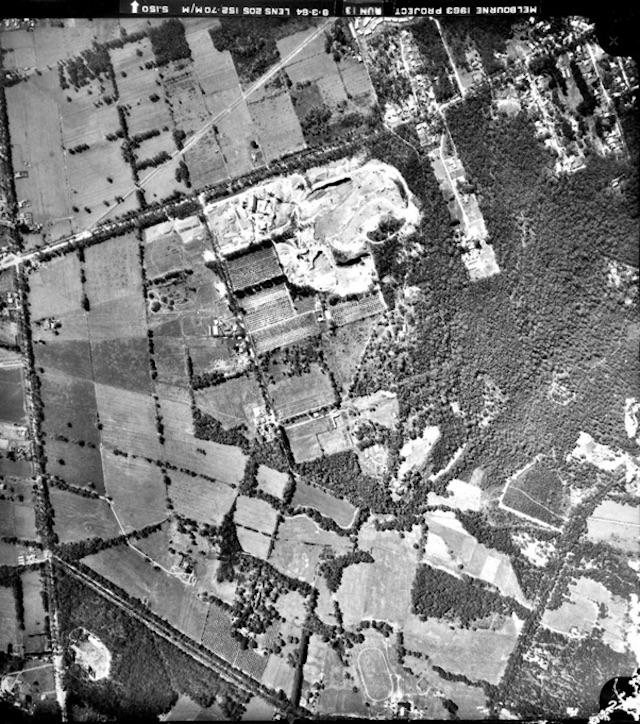
A Boral spokesperson said the quarry pre-dates the residential growth of Montrose, providing a photo from 1963 to help visualise this fact.
“This is not a brand new greenfield quarry application. Monrose Quarry has been operational for more than 70 years, and pre-dates much of the residential and other sensitive development that surrounds the site today,” they said.
“The 500m ‘buffer zone’ is contained in guidelines published by EPA Victoria in 2024. These guidelines are not fixed legal requirements and can be varied if it is demonstrated that an alternative (shorter) distance poses a low risk to human health and amenity.”
The spokesperson also noted that “the guidelines protect the existing and expanded operations at the quarry from inappropriate land use and development nearby that may constrain our operations”.
Councillor Len Cox described this as “an unmitigated disaster if it goes through”.
A hill, known as Callams Ridge, has been a divide between much of the housing and Billanook Primary School, but under the 30-year proposal, Mr Dane said “Callams ridge is going to disappear”.
This was noted by Dr Chris Fildes that it “puts Billanook in the direct firing line”.
Because of the fears expressed by the community relating to the closeness of the blasting zone to houses and schools, Star Mail requested Boral outline what standards, protections and risk mitigation would be followed should the proposal be approved.
In relation to dust, the spokesperson said, alongside a negative pressure dust collection system within the enclosed processing plant, the site was also going to be fitted with additional monitors in January, bringing the total up to four.
“There are two real time dust monitors surrounding the site, that measure dust in the atmosphere, and when it approaches the limits, it alerts site management so that they can take corrective action such as turning off certain plant and equipment or undertaking further wet spraying of haul roads and stockpiles.”
Blasting currently can only occur during certain times of the day. Boral implements a 10am to 4pm window on weekdays, and the blast impact assessment indicates that it would be “prohibited on weekends and public holidays as part of future operating conditions”.
“The quarry carefully plans each blast to ensure it is detonated in a very controlled and safe manner and in accordance with the approved mine plan,” the spokesperson said.
“At present there are five blast monitors located at residences surrounding the site to ensure the quarry achieves compliance with ground vibration and airblast overpressure criteria.”
The spokesperson said “some noise mitigation measures (are) employed” including bunds and noise walls, broadband reversing alarms fitted to mobile plant equipment and maintenance of on-site plant equipment to ensure noise levels don’t increase over time.
Mr Dane said the destruction of Callams Ridge will “be an irreversible impact of major significance” most likely leading to “a lot more dust, a lot more noise”.